
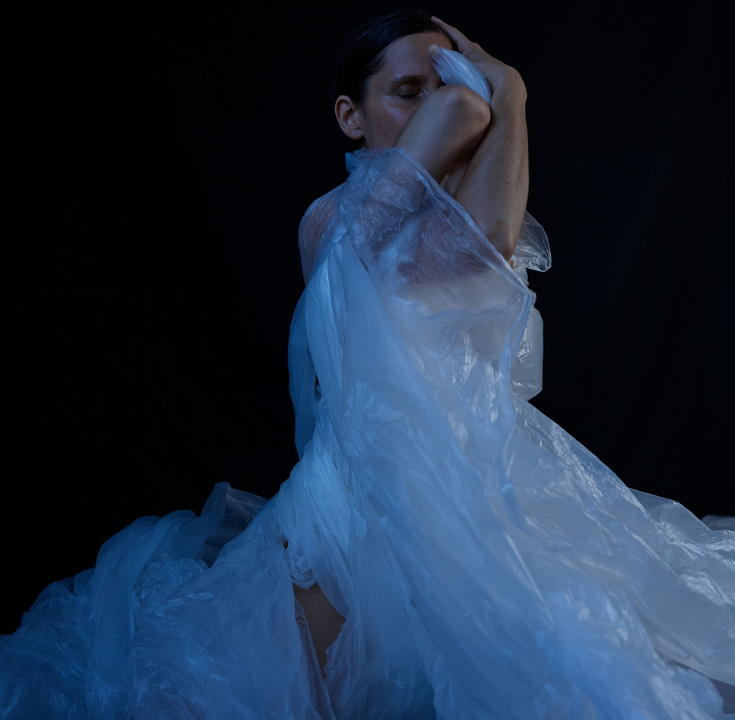
HUELLA opens Sunday 8th November at The Cockpit, exploring an ambiguous waterfall carrying the memory of water. Learn more about what you can expect:
1. What inspired you to create HUELLA?
I wanted to explore themes of solastalgia, the decentring of anthropocentric perspectives, and the possibility of creating a more-than-human dramaturgy in the context of the ecological crisis.
Water became central to this inquiry because it connects all forms of life, human and non-human alike. Against the backdrop of the global water crisis, I was interested in its memory, its transformations and the traces we leave upon it.
I’ve always been deeply inspired by Federico García Lorca’s poetry, particularly his symbolic relationship with nature. I wanted to develop an eco-poetic narrative in which the natural world could have its own perspective, where a landscape becomes a witness and narrator, carrying memories of human and non-human lives.
I was also drawn to everyday synthetic materials, particularly plastic, and their possibilities as sculptural, sonic and performative matter.
Drawing from Vogue, particularly New Way and Arms Control, as well as flamenco aesthetics, I began questioning how these movement languages could embody more-than-human experiences. What might they reveal when brought into a narrative that seeks to move beyond the human perspective?
2. The piece centres around an ambiguous waterfall. What drew you to this concept?
For me, a waterfall evokes something pristine, immaculate, almost dreamlike. The sound of flowing water, its freshness, its movement, the beauty of the surrounding landscape. It’s also a rich ecosystem, inhabited by animals, plants, mosses and countless forms of freshwater life. Waterfalls hold memories of play, intimacy and contemplation, alongside the histories of the other living beings that inhabit them.
I began imagining a radical transformation of this landscape. What if the water itself disappeared, leaving behind a strange formation of synthetic matter, contaminant residues and technofossils? What would remain of the waterfall and the lives and memories it once carried?
This idea emerged from my interest in solastalgia and the transformations we’re already witnessing: disappearing waterways, climate change, increasing water stress, and growing pressures on freshwater resources, including the demands associated with AI infrastructure and data centres.
During my research, I became fascinated by phenomena such as plastiglomerates and the plastisphere, and by the emergence of new geologies shaped by human activity. These discoveries resonated with the speculative landscape I was imagining, where the effects of the Anthropocene and Capitalocene are pushed to an extreme.
There’s something almost science-fictional about such a transformation. Yet, in many ways, we’re already living in a kind of science fiction of the everyday.
I was drawn to the unsettling contrast between an immaculate waterfall and a landscape transformed beyond recognition. In HUELLA, the waterfall becomes a witnessing presence, carrying its memories across ambiguous temporalities, somewhere between an altered present and a possible future.
3. What can body movements teach us about different themes?
My movement practice is rooted primarily in club dance cultures. I’m a Vogue performer in the Iconic House of Milan and have been part of London’s ballroom scene since 2020, walking balls internationally in the New Way and Arms Control categories. My practice also incorporates flamenco, improvisation and somatic approaches.
In HUELLA, through the articulation of fingers, hands, wrists and arms, and the precision of lines, angles, circles and illusions, I embody narratives and sensations of fluidity, delicacy and playfulness, alongside more intimate states connected to our sensory memories of water. I also work with the felt pressure and tension of water held within an altered landscape, approaching these sensations from the waterfall’s own perspective. At other moments, my movement becomes mechanical, detached or nonchalant, evoking aspects of human presence and the transformations of the Anthropocene.
Flamenco aesthetics bring a profound connection to the earth, nature and cultural memory. I’m drawn to the almost sacred intensity of flamenco, particularly through its music and cante, where grief and longing can coexist with a profound sense of dignity. In HUELLA, that emotional intensity extends to the landscape itself, evoking its losses and the memories it carries.
Through somatic improvisation and contortion, the latter drawing on my New Way Vogue practice, I also enter more introspective, almost ritualistic states.
Working with objects and synthetic materials is equally important to me. I approach them not simply as props, but as presences that can become extensions of my body, suggest habitats or landscapes, and transform the way I move and perceive space.
4. What would you like audiences to take away from the piece?
Above all, I hope HUELLA can invite audiences to experience the world from a more-than-human perspective. The waterfall is not simply the backdrop to a human story; it becomes the narrator, a witnessing presence carrying memories of human and non-human life.
I would love the piece to evoke empathy, humility and respect towards the living ecosystems we are part of. Water connects us across different forms of life, revealing how profoundly interdependent we are, even as the systems we inhabit often distance us from that relationship.
I’m also interested in the cognitive dissonance we experience in our everyday lives. We may be aware of the ecological crisis, yet remain caught within systems and habits that contribute to it. I experience these contradictions myself.
Rather than prescribing a particular response, I hope the piece opens a space for awareness and reflection, inviting us to reconsider our relationship with water, matter and the environments around us with empathy and care.
5. Where would you like the production to go next?
I would love to tour HUELLA, share it with different audiences and discover how the work resonates in different contexts. I’m particularly interested in the exchanges that can emerge from these encounters, and how audience responses might inform the research.
I see HUELLA as an ongoing, non-linear artistic inquiry into water, memory, ecological transformation and more-than-human narratives. The work can continue to evolve through different performance formats, installations, poetry and further experimentation.
I’m also interested in collaborations across artistic disciplines, exchanges with scientists and workshops exploring aspects of the work through movement, materials and sensory experiences.
6. What has been the most enjoyable part about creating HUELLA?
What I’ve enjoyed most is developing HUELLA as a transdisciplinary work, where dance, poetry, traditional music, sound experimentation and installation shape the waterfall’s narrative and our relationship with water.
I’ve always found waterfalls incredibly beautiful and dreamlike, so beginning with that image and gradually developing an entire artistic world around it has been particularly exciting.
I’ve spent several months developing the dramaturgy, exploring Lorca’s poetry, researching ecological transformations and experimenting with synthetic materials. Discovering how these different strands of research could take shape within the work has been a fascinating process.
Collaboration has also been central to HUELLA. Working with artists from different backgrounds has brought distinct perspectives and sensibilities to the piece: Santiago Jara (soundscapes, Chile), Michael McMahon (guitar composition, UK), Carlos de Luisa (singing and spoken poetry, Spain), Amber Jiang (wearables, China) and Emma Gasson (lighting, UK).
HUELLA opens Sunday 8th November at The Cockpit. Many thanks to Isadora for answering our questions. Book your tickets here!
Max
Leave a Reply