
10 Loves opens Monday 5th October at the Bread & Roses Theatre, exploring a two-hander play about intimacy, labour, hope and survival. Learn more about what you can expect:
1. What inspired 10 Loves?
10 Loves grew quite directly out of my own experience of working-class life. I currently support myself mainly through retail work, and I became increasingly aware of how much time, energy and emotional capacity that kind of work can consume. After work, I would sometimes struggle not only to continue making theatre, which is the reason I work to support myself in the first place, but even to talk to friends and family.
I was working to sustain the things I cared about, while the work itself was gradually taking away my capacity to care about them. I started talking to other working-class theatre-makers, including the actors in 10 Loves, and recognised similar tensions in their lives.
I chose romantic love as a more universal and immediately recognisable way of exploring that contradiction, and imagined a law that literally forces people to keep expressing love. For me, the law grew from the feeling of having to tell myself: you cannot become numb; you have to keep caring, because otherwise what is all this work for?
That was really where 10 Loves started. What happens when something you desperately want to preserve starts to feel like one more thing you have to do?
2. What do you think the government is really trying to protect?
The government in the play exists within a framework that audiences will probably recognise from many dystopian stories. We’re used to seeing systems that regulate private life and intimacy as something threatening or oppressive.
But I wanted to use that familiar framework without giving a simple answer about what the government represents, or whether what it’s doing is entirely benevolent or oppressive.
What interests me is the gap between what a society says it values and wants to protect, and whether it actually gives people the conditions to sustain those things. Society may encourage love, intimacy and connection, but that doesn’t necessarily mean it supports people’s ability to maintain them.
I’d rather allow different audiences to arrive at different answers about what the government is protecting, and whether it is helping, harming, or simply revealing pressures that were already there.
3. What does the play suggest about the difference between having time together and actually connecting with someone?
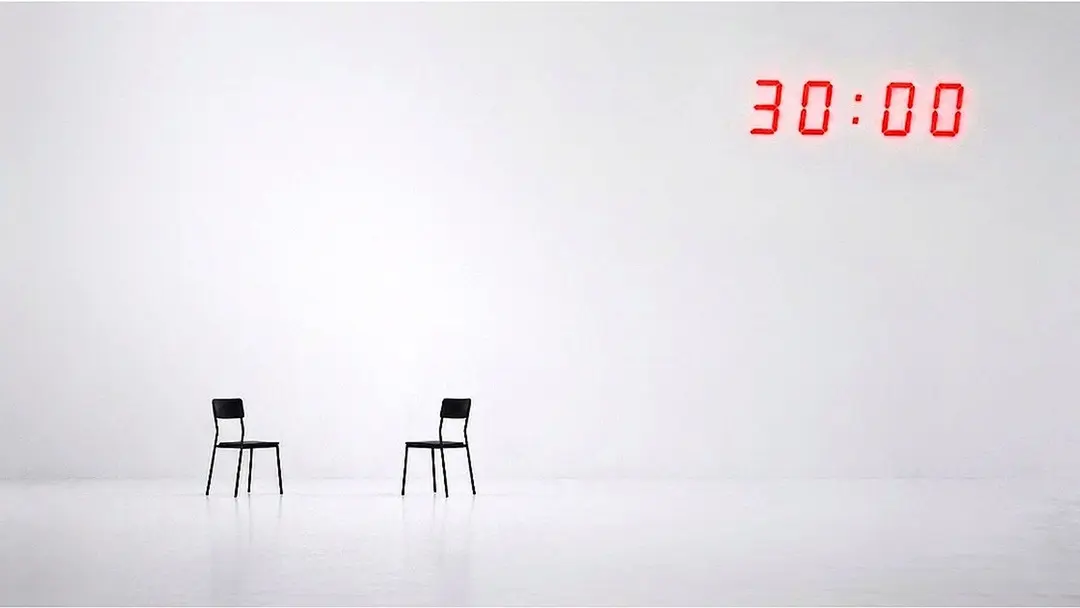
I think the play questions whether time, language or particular expressions of love can ever fully describe the connection between two people. Spending thirty minutes together or saying “I love you” ten times gives intimacy a visible, measurable form, but what those things mean can change enormously over time.
Sometimes “I love you” can hurt, or even become a form of attack. Sometimes silence can be an expression of love. I’m interested in that gap between the visible forms of intimacy and what those forms might mean between two people, rather than defining that connection for the audience.
4. How did you approach portraying a relationship that changes over time?
In writing and directing the relationship, I was less interested in changing the two people themselves, and more interested in gradually narrowing the world around them.
When I was writing it, I kept imagining their love as a small platform with the two of them standing on it. At first, there was plenty of space around it. Work, money, exhaustion and responsibility could all sit somewhere else. But as that outside space became smaller, there was nowhere else to put them, so they all ended up on the platform with the two of them.
Maybe they can no longer move towards each other as freely as they used to. Or maybe they’re pushed so close together that they can’t really see each other’s faces anymore. So even if they remain the same two people from beginning to end, the relationship between them can still change.
“I love you” works in the same way. At first, it can simply mean “I love you”. Later, it has to carry reassurance, apology, responsibility, expectation, even hurt. By that point, how much room is still left for the simple “I love you” that was there at the beginning?
5. What do you want audiences to take away?
I don’t think I want audiences to take away one particular answer. They might leave with questions. What do I make of the government and the law? Do these two people still love each other? Where do they go from here? Or maybe it’s something much less defined, just a simple “what if?”
But they might not be able to turn what they’re feeling into a question at all. Maybe it’s a sense that something has been lost, maybe they’re not quite sure what to make of what they’ve just seen, maybe there’s some hope, or just a slight sting. I’m happy for any of those things to stay with them.
6. What has been the most enjoyable part about creating 10 Loves?
One of the things I’ve enjoyed most is discovering how much more there is in the play every time we go back into it. Sometimes I’ll notice something during text work that I wrote quite instinctively, and realise that it connects with something much later, or reveals a side of a character that I hadn’t consciously planned. It almost feels as if the characters have come alive and are genuinely living in the world of the play, making choices that are true to who they are before I’ve even consciously analysed why.
Then it happens again in rehearsal. I’ll discuss something with the actors, they’ll try it, and what they bring can open up another side that I hadn’t seen before, while still connecting back to what was already there. 10 Loves is the first original production I’ve written and directed professionally, and going through that process has given me even more confidence in my instincts as both a writer and a director. The more we discover, the more I can trust the work and allow myself to go further with it. I find that incredibly satisfying.
10 Loves opens Monday 5th October at the Bread & Roses Theatre. Many thanks to Sining Gui for answering our questions. Book your tickets here!
Leave a Reply