
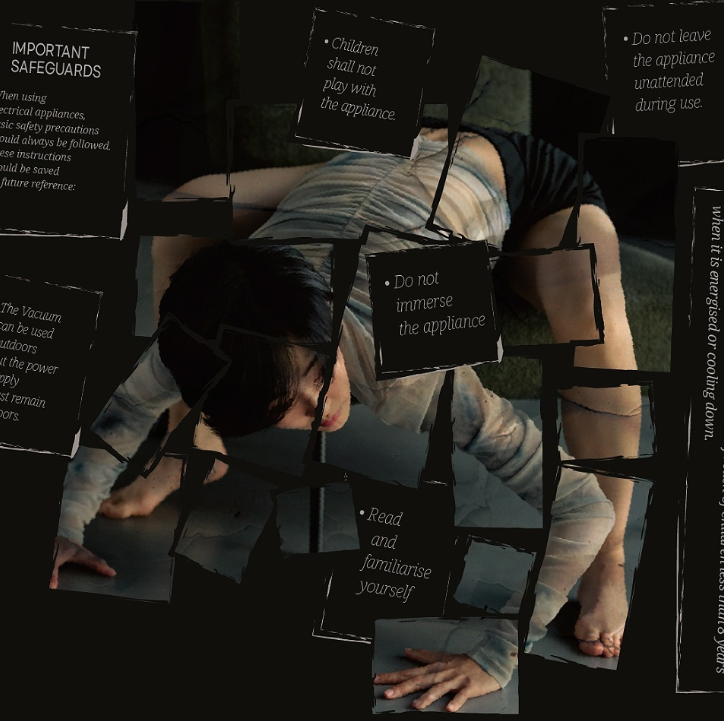
User Manual for a Broken Machine opens Wednesday 11th November at Theatro Technis, combining sound, movement and vocal perforamcne to create a visual piece. Learn more about what you can expect:
1. What inspired User Manual for a Broken Machine?
It started with a broken Daewoo vacuum cleaner and its instruction manual. I saw my housemate trying to fix the machine by following the instructions, but nothing worked. Then I realise that it was the brand that I know very well: Daewoo. It’s a Korean brand, that has specific historical context, and the company once that I used to work for. In the end, she decided to throw it away, and it was not even easy to recycle. It felt metaphoric. A broken Korean vacuum cleaner in the middle of London flat. Broken and exhausted.
First, I felt for the machine, then I wonder, is it the machine that was broken, or was it the manual? Or was it the system? Then who defines what functions and what doesn’t? As a migrant who has lived in Korea, the US and the UK, I’ve often felt that we are constantly given instructions on how to fit into different systems. But what happens when those instructions don’t work? I decided to resurrect the machine in my own way, so I made a show.
2. What does it mean to be labelled a ‘broken machine’?
I think the word ‘broken’ imposes the meaning that there is a norm. We are all asked to follow the norm, the function that we are supposed to do in that social needs, but I wanted to question that. Who defines what is broken? And how can humans be defined by their function?
This relates to our company, KASSNA. Kassna meant a woman who wears mens’ hat in old Korean in southern part of the country, but it developed into a derogatory term in contemporary Korean language. I guess it is because they did something out of their social expectation and norm. So women wearing men’s hat, meant, broken, not functional, wrong. I wanted to reclaim that title, reclaim the perspective who defines who or what is broken.
3. Does the show suggest that the individual is broken or that the system itself is broken?
It starts with a person literally trying to fix the machine. Then it develops into the story of an individual trying her best to become a good part of the machine. The more she tries, the more broken she becomes, then she wonders, “is it really me that is broken?”
We are constantly told to improve ourselves, become more resilient, more efficient, more productive. But what if the instructions themselves are impossible to follow? What if the system is designed so that someone must inevitably fail?
I don’t want to give the audience a simple answer. I’m more interested in questioning who has the authority to decide what is broken. Perhaps refusing to function according to the instructions isn’t always a failure. Perhaps it’s a form of resistance.
4. How does the sound communicate something that words alone cannot?
I think words can be deceptive because they pretend to deliver all the information. Sound, on the other hand, is what I would call violent. It doesn’t compromise. The moment it begins, it sets the tone, directs our attention and shapes how we feel. For me, sound is another language, an emotional gesture towards the audience.
In this show, electronic and distorted sounds meet the piri, a traditional Korean wind instrument. The tension between these sounds creates a jarring sensation, as if the past and present are colliding. It raises a question: are we really just individuals, or are we the result of histories we may not even know? What happened before us still shapes who we are today. An individual is never just an individual, but part of others, society and the world.
Words can tell us what to do, but sound makes us physically experience control, repetition, frustration and resistance. And I love that sound doesn’t always need translation.
5. Where would you like the production to go next?
I see this show as a versatile piece that can adapt to various environments. In early October, we had our first preview in a church, which gave the show another layer of meaning. For Voila!, we’re incorporating live cinema and an AI avatar to add more layers to the story. Aesthetically, I want the show to be made up of layers of systems and theatrical languages, starting with text, then moving into music, movement and technology.
I would love to find a venue where the show could have a longer run. Then I’d love to tour the production across the UK and internationally, to various festivals that focuses on physical theatre, or to places where questions of labour, migration and productivity resonate differently.
I’d love to see how the piece evolves in different cultural contexts. After all, every society seems to have its own instruction manual for how people should function.
6. What has been the most enjoyable part about creating User Manual for a Broken Machine?
The collaborative process itself, I would say, was ideal. Everybody was respectful of each other while remaining professional in their own roles. I intentionally chose one person to represent each theatrical language, and the way we collaborated was quite organic and mutual.
I really enjoyed working with everyone because of their professionalism. Another unique thing about our show is that all the cast members are also creatives. We started calling ourselves ‘vending machines’ because the moment I asked for something, they were already producing it on the spot!
User Manual for a Broken Machine opens Wednesday 11th November at Theatro Technis. Many thanks to Namoo Chae Lee for answering our questions. Book your tickets here!
Leave a Reply