
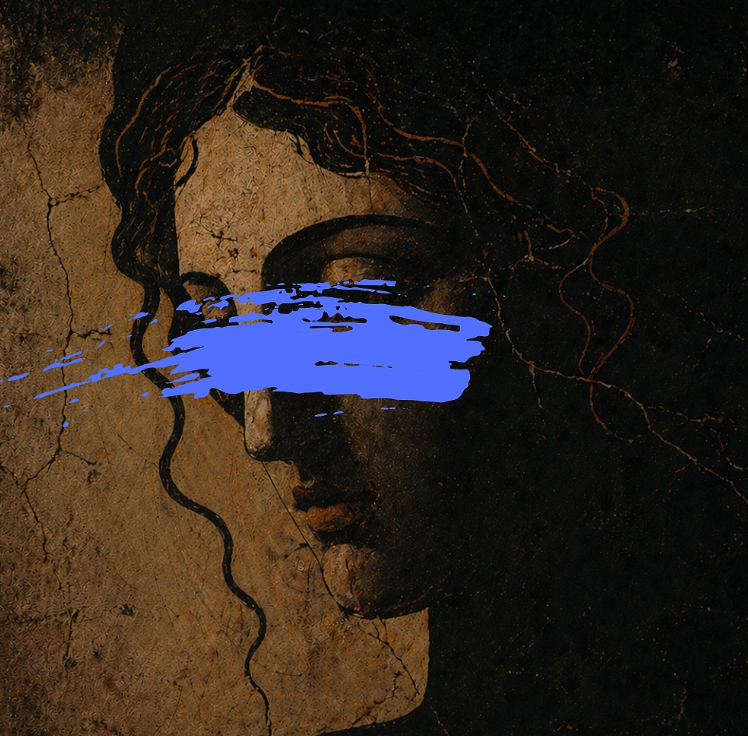
Dogfaced opens Monday 16th November at the Barons Court Theatre, exploring Helen of Troy based on original translations of ancient texts. Learn more about what you can expect:
1: How has the original text been updated to reflect the current production?
I studied classics before going to drama school, and I am passionate about using my knowledge of the ancient languages to (re)tell its stories from a new, female, perspective. All the stories we have of women in Ancient Greece and Rome has come to us through male writers, male translators, and male scholars, who have shaped the way we view them. In my research and work I try to find the women behind those male interpretations and give them their voice back.
For this play I wanted to focus on the story of Helen of Troy. I started with researching every single mention of Helen in Ancient Greek and Roman literature, and read Bethany Hughes’ and Ruby Blondell’s books on Helen’s story to get an idea of which narratives would be most interesting to use. I looked at the ancient sources they both mentioned and found the original texts, which I then carefully translated: sometimes staying very close to the Greek/Latin text (for example with my direct translations of Helen’s scenes in the Iliad), sometimes imagining scenes based on information that was given (I turned the letters Paris and Helen wrote to each other in Ovid’s Heroides into the active dinner scene they were describing), and sometimes doing the opposite and turning entire scenes or accounts into one single thought.
These scenes I then combined into one play, set on the last day of the Trojan War, with a chorus of three Helens looking over her memories. The three Helens are different voices inside Helen’s mind, different ideas about who she is. Helen is battling her own thoughts and feelings about herself and her actions, using different memories and narratives to blame or find a reason to absolve herself. As a woman you are always aware of being judged, being looked at, perhaps being blamed for things you had or had no control over. We constantly judge ourselves. The Helens are aware of that judgment and try to use it to their advantage, by presenting their case to their imagined audience, hoping that the truth, the whole truth, and nothing but (their) truth will set them free.
2: What inspired you to explore Helen of Troy and what aspect of her character do you find more intriguing?
Helen was one of the characters I looked into in my last play ECHOES, about the silencing of female voices in ancient mythology. What I loved was how complex she is, and how differently everyone described her. She was a seductress, she was a victim, she was a princess, she was a whore, she was manipulative, she was abducted, she supported the Trojans, she wanted to be back in Sparta… The point of her story to me is that all these (often male) authors have written so many different and conflicting things about her, but she’s never been allowed to tell her own story. She has become an inspiration, an idea, more than a human woman. And I wanted to find the woman behind all of these myths. Helen is not, and could never be, one thing. Helen could also never look like one woman, one idea of beauty, which is why I chose to go for three Helens: Helen could be any woman, and perhaps is every woman. Maybe all these contradicting qualities can in fact coexist in the mind of someone who does not know how she feels about herself.
3: Helen of Troy is a complex individual which is navigated through the piece by three Helens. How does each individual bring their own take to the role?
The three Helens are based on the three dominant views the ancient writers have of her, and on the philosophical ideas of “logos”, “pathos”, and “eros”
Helen 1 is the logical one. The Helen who tries to take control of the narrative and of her life by thinking of every possibility and every outcome, in the hope that she can rationalise her way out of her situation. She is based on accounts of Gorgias (who wrote a text trying to absolve Helen of all fault, no matter why she ended up in Troy); Colluthus, where she says she “prides herself on knowing everyone”, and “she knows all the rivers and paths around Sparta, and would never get lost”; Euripides, where she argues masterfully with Hecuba and Menelaos to save her life in Trojan Women; Ovid, who has her write a letter to Paris where she slowly convinces herself to go with him; and Homer, where she is always the one leading the conversation, especially in the Odyssey, where she clocks who Telemachos is long before anyone else does. There is a line in the Odyssey where she says “should I lie or tell the truth?” and we never find out which route she chooses when she starts to speak, but we know she is aware of her choices.
Helen 2 is pathos. She is the emotional, guilt-ridden version of Helen. The one who, in Homer, continuously calls herself “dogfaced”, and blames herself for everything that has happened. She is the embodiment of the blame women put on themselves when they believe they could have prevented a situation, because society has told and taught us that it is always our fault when (we make) men do horrible things. She is based on Euripides’ Helen, who is innocent, pure, and naïve (and was in Egypt while the battle was fought out in her name over a fake Helen), and on Homer’s Helen, if we choose to believe that what she says is what she means.
Helen 3 is eros. She is the seductress, the one who knows how to use her beauty and sensuality to get what she wants. She is the manipulative realist, who knows how to turn the male gaze to her own advantage, and sees power in her status as the “woman whose face launched a thousand ships”. She is mostly based Euripides’ version in Trojan Women, and on the image of Helen weaving the war into a tapestry in the Iliad (holding the threads and the fate of the men in her hands) but also on the many writers that throughout history sexualised and othered her as something to be feared.
4: Where would you like the production to go next?
I would love to develop the piece further and potentially bring it to Edinburgh Fringe next summer!
5: If rehearsals have started, what has been the most memorable moment so far?
It might be a cop-out, but I am genuinely enjoying every second of the rehearsals so far. We work together really well as a team, and the room is full of positivity and ideas. Our director (Morgan Chalmers) has amazing visions for scenes and it’s funny how often I felt like she could read my mind and add to it, offering and extracting ideas I had subconsciously envisioned whilst writing, without having been able to put them into the words in the script. I also love seeing how each of the actresses is starting to think like their character in our interpretations of scenes and see their interpretation as the truth, when in fact it is a perspective, that (thankfully) due to the nature of the play, can coexist with the perspectives of the other Helens.
6: What has been the most enjoyable part about creating Dogfaced?
Probably seeing my writing come to life in the rehearsal room. As a writer it is amazing to see actors pick up your words and do something unexpected with them, make them their own, and see how the world you imagined actually can exist in the real world, in a way better form than you originally envisioned.
Dogfaced opens Monday 16th November at the Barons Court Theatre. Many thanks to Lieve de Putter for answering our questions. Book your tickets here!
Leave a Reply