
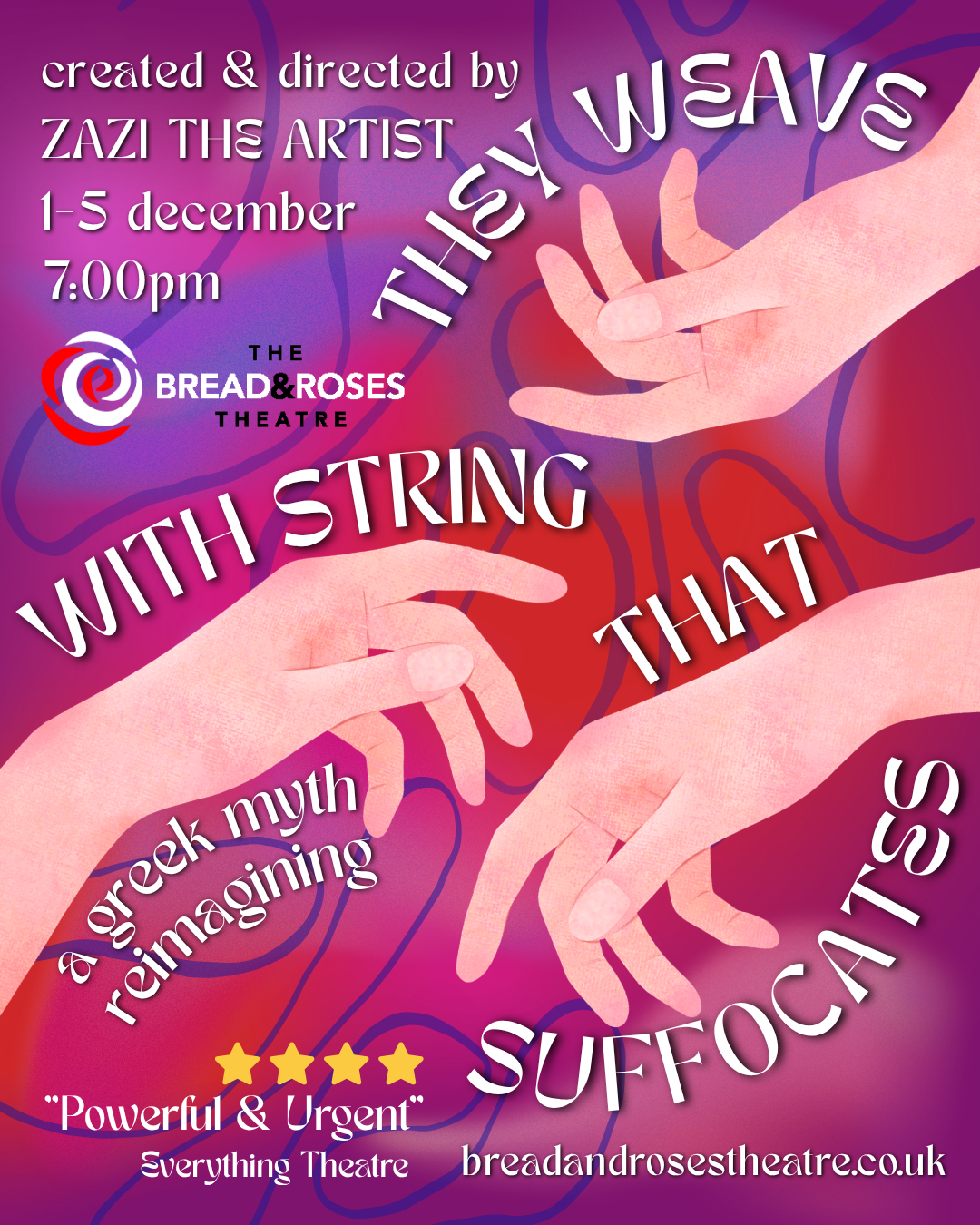
They Weave with String that Suffocates opens Tuesday 1st December at the Bread and Roses Theatre, reimagining the complex and interwoven stories of six women from Greek mythology through the eyes of the Fates. Learn more about what you can expect:
1: What inspired They Weave with String that Suffocates?
It started as my first year creative project for my master’s degree. I was tasked to direct a 50 minute piece of my choosing, and I decided to do a Greek myth reimagining in order to make my bachelor’s degree mean something in this new chapter of my life. I also have a huge passion for writing, and knew I wanted to write my own piece. I had recently read “Elektra” by Jennifer Saint, which retells the stories of Klytemnestra, Elektra, and Kassandra. Having been so inspired by this book, I decided to write the show “The Woman of the House of Atreus” about those three women. One of my classmates had directed a scene where the actors sat in a pile of string, which made an impression on me and later inspired my own use of string. I had the idea to have the performers connected at the wrist with string because of how intertwined the characters are, and how they push and pull at each other’s fates. After a mildly successful run, I realized the narrative was muddled and the flow between characters was confusing. Because of that, I added the Fates as a framing device to clarify the narrative, and added small costume pieces to distinguish characters. Finally, I added three more characters – Helen, Iphigenia, and Khrysothemis – because I decided they were just as involved in the narrative I was telling as Klytemnestra, Elektra, and Kassandra. I changed the name to “They Weave with String that Suffocates” to better represent the new show and boom! The show as we know it was born 🙂
2: The production is described as an homage to female rage. What does this mean to you?
Female rage, to me, is the anger felt by women at the injustice of misogyny and the lack of autonomy dating from antiquity through to modern day. This show highlights the rage felt by these timeless women – Klytemnestra, Helen, Iphigenia, Khrysothemis, Elektra, and Kassandra – because of the greed of the men around them, or the consequences of the actions of the men around them. They are stripped of their innocence, victims of sexual assault, survivors of grief, and taken without their consent. These are experiences many women can relate to in some way or another that I did my best to represent justly in the show. I also think that there is a lot of rage towards other women that can be classified as female rage because the root of it stems from the actions of men. For example, the rage Elektra feels towards Klytemnestra stems from Klytemnestra’s murder of her husband and Elektra’s father, Agamemnon. However, Klytemnestra only murders him because he sacrificed their eldest daughter for a fair wind to Troy for the Trojan War. If Agamemnon hadn’t acted as selfishly as he did, he would still be alive and Elektra would have no reason to rage. The circumstances that these women face throughout the show epitomizes the timeless reality of female rage.
3: How has the creative journey been so far?
It has been a dream come true! This run has had the biggest creative team in the history of the show, with a choreographer, a costumer, and a lighting designer joining the team. My assistant director, who has been with the show for the past two runs with UEL and then the Lambeth Fringe, has also taken up the mantel of sound designer. These additions elevated the piece and took it to a level I could’ve only ever dreamed of. I am so grateful to them and all of the work they’ve put in. We’ve also had three completely new actors join the cast, making the entire cast fresh faces. They have honored me as a director and playwright by believing in the show, and caring enough about it to challenge the piece and ask questions where necessary. They’re contributions have clarified my own perception of the show, and I am eternally grateful to them for putting their all into the piece every rehearsal. I love my team so incredibly much, and (if I haven’t said it enough) am so grateful for each and every one of them!
4: Was there a particular myth of character which you found compelling when developing the play?
I knew quite a bit about each character going into this process because of my bachelor’s degree in classics, so I unfortunately didn’t discover much throughout it. However, a character that I’ve always loved and had a soft spot for is Klytemnestra. She has been villainized throughout history for the murder of Agamemnon, but ever since I first heard of her in my first year of undergrad I’ve sympathized with her. To have your child murdered in front of you by your own husband must be one of the most painful experiences one could have. To then demand the life of your husband in turn seems to me to be the only logical reaction. On the other hand, a character I had a hard time understanding is Elektra. She resents her mother for killing her father, despite her father’s horrendous deed. I couldn’t wrap my head around Elektra’s forgiveness for her father, until I realized how much she must love him to forgive him for such a heinous act. I used that love as an anchor, and it has been a tremendous insight into her character.
5: The show combines surrealism, physical theatre and lyrical dialogue. How do you combine these different theatrical elements?
I think all of those elements blend together really well, and can come from each other. The lyrical dialogue came first, as I’m a poet at heart and know no other way of writing. I knew I wanted poetry at the heart of the dialogue, and that inherently brings a certain level of surrealism to the piece. The characters don’t talk like us, but they feel like us, and that creates a surreal tone. From the surrealism and lyrical dialogue, the only logical movement style is dance. However, the show isn’t a musical, it’s a play. I didn’t want there to be pirouettes or leaps or anything like that. Which only left physical theatre, what I feel like is the poetry of the body if dancing is the singing of the body. Physical theatre still has a rhythm to it, but it’s not as dance-y. It feels like the perfect compromise for the type of show I wanted to create.
6: What has been the most enjoyable part about creating They Weave with String that Suffocates?
The most enjoyable part has been honing my theatrical craft while pursuing one of my greatest passions: classics. I absolutely love ancient Greek literature, drama, and mythology. I feel so connected to these ancient humans, and it’s an honor to carry on the torch of their timeless stories. I’m but one in a long line of storytellers for these myths, and it’s an absolute honor. To tell these stories through theatre is a true privilege. I love everything about theatre, from the production to the design to the acting. I believe it’s the ultimate art form, relying on collaboration, skill, technique, and an artist’s spirit to make it come to life. To be creating theatre about classics, well that’s just a dream come true!
They Weave with Strings that Suffocates opens Tuesday 1st December at the Bread and Roses Theatre. Many thanks to Zazi the Artist for answering our questions. Book your tickets here!
Leave a Reply