
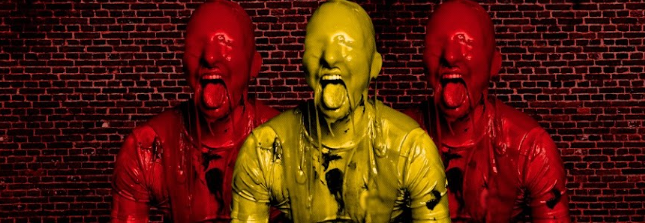
(a play in a) DARK ROOM opens Sunday 17th January at The Divine, introducing audiences to Davis the Janitor who cleans up all sorts of bodily fluids at his job. Learn more about what you can expect:
1: What inspired you to create (a play in a) DARK ROOM?
DARK ROOM was written after the first performances of my other fringe show PUP PLAY. I wrote PUP PLAY to be an honest celebration of the pup community with a positive message of self-acceptance. But despite that, PUP PLAY went through (and continues to face) an endless struggle in producing (censorship and death threats to name a few). The entire audience was forced by a fringe to sign consent forms just to watch the first performances. Many theatres and people assume, because of that pup hood and the brief marketing pitch, it must be a filthy, disgusting sex show. I must be a dumb dog with nothing to say.
Then, I had the first few performances. Several audience members came up to me and said: “You know, that really wasn’t that bad! I thought it was just going to be porn. I dunno what all the fuss was about.” People were shocked the show was emotionally introspective, beautiful, and yah know… about something. And that bigoted bias towards my work angered me… I said to myself: “I’ll show you what I consider to be a nightmare.” The first draft of DARK ROOM was then written in the viscera of PUP PLAY‘s birth. The content, themes, and intensity of DARK ROOM make PUP PLAY look like family entertainment. But perhaps most ironically, DARK ROOM has had practically none of the threat, violence, and censorship of PUP PLAY, despite it being an undoubtedly more controversial and intense work. I suppose there’s something about pup hoods that angers people more than gallons of fake cum? Or maybe people have just learned to treat my writing with some respect?
2: The show has been described as a queer psychological thriller/horror. What does queer horror mean to you and what do you think it can explore that other genres sometimes can’t?
Queer horror is about subverting what is considered horrifying. Horror often treats the unknown, different, and weird as something of terror or disgust. Queer people are different, and under the rules of horror, must be terrifying. Queer horror flips that thinking. A central theme throughout (a play in a) DARK ROOM is about what should scare and disgust us, and why? DARK ROOM has lots of gross things in it, but it demands we remember what is truly disgusting. With the nature of what is explored in the show, there is no better genre than horror/thriller for this show. That all said, this work is not all horror and gloom. It is horrific, but its ultimate purpose is not to scare or thrill. It’s quite hopeful – an almost Dante Inferno journey led by the hand into hell and out into hope. The show seeks to remind us why in spite of all the horror we continue to be queer.
3: What makes the dark room such an interesting setting for a horror story?
Darkness is often something which is feared. It is a place where hideous things go to hide. However, in this queer context, it’s a place of celebration and freedom. The dark red light reveals bright glimpses of utopia. Again, we see how queer horror subverts the tradition of what is horror. Here, the literal darkness is not something to fear. It’s the external and encroaching darkness outside the gay bar which is the horror. There’s nothing scary about consenting sex between men in a dark room.
4: Do you think audiences will sympathise with Davis, fear him or perhaps feel uncomfortable around him?
It’s all three if I’m honest. Davis is a noble person with strong morals. He is proud of being the ‘pig of pigs.’ He loves who he is and he loves his community. He will do anything he has to do to protect that community. That is where he is also most terrifying and will make people feel uncomfortable. On the more positive side, he is terrifying because he is liberated from the opinions of others. He pisses where he pleases and he has a few choice words to you if you find that gross. He is unapologetically a queer pig who loves who he is. He says it at the start “I’m Davis – the pig of pigs. And I hope that makes you uncomfortable.” On the other hand, and the more sinister angle which the show explores, because he loves his community, he will do anything to protect it. He will justify horrible, hateful actions if he believes it will protect and avenge those he loves. That noble characteristic, tainted by the scars of hate and paranoia, becomes a driving impetus for the show’s psychological spiral towards extreme violence.
5: How has the show evolved since its premiere at Colchester Fringe in October?
The biggest way is simply learning how the audience responds to the piece. What I love about a first performance is where you finally hear where the audience laughs, gasps, and shrieks. It informs every future performance and edit. Likewise, I see the show through the eyes of the objective audience. They ask me questions which make me see the show differently or know where to clarify the themes or characters. I start asking deeper questions about my performance: Did my movement work here? What parts do I need to tighten? Did I use too much fake cum? How long do I hold this pause? Am I switching between these characters clearly? Is the volume of our score too loud? That is what I enjoy most in touring and growing with this show. You start to discover the piece as not text on page but as a conversation between the audience and yourself. It’s now a living and breathing organism that is learning how to run.
6: What has been the most enjoyable part about creating (a play in a) DARK ROOM?
First, and the more important one, is hearing the audience feedback. To be honest, I was prepared for and expected the worst. Instead, audiences have thus far surprised me with their universally positive reaction. They talk to me about how much it emotionally resonated with them; how the show challenged, overwhelmed, and surprised them. They talk to me of past traumas and future hopes. A few people told me the show “triggered and overwhelmed” them in a good way – reminding them of past hate and how they handled it at the time.
As an artist, the reaction I do not want is: “that was good.” Good is an exasperated sigh and a non-chalantness that fills me dread. DARK ROOM’s reaction has been that of provocation, of thematically dissecting the work, of unpicking the audience’s own complex lives, and of deep political conversations about queerness. That’s what has been the most enjoyable part. It’s why I beat myself up, physically exasperate, and go through hell to do this show. The audience, I hope, is provoked to understand my community, to make changes for it, and treat everyone with more empathy.
The second most enjoyable part is all the mess I get to make on stage. It is a joy to be a messy kinky gremlin for an hour. It’s not a joy to clean up, but oh boy, is it fun to pour all that fake cum (and other fluids) on my face every performance.
(a play in a) DARK ROOM opens Sunday 17th January at The Divine. Many thanks to Dr. Pants for answering our questions. Book your tickets here!
Leave a Reply