
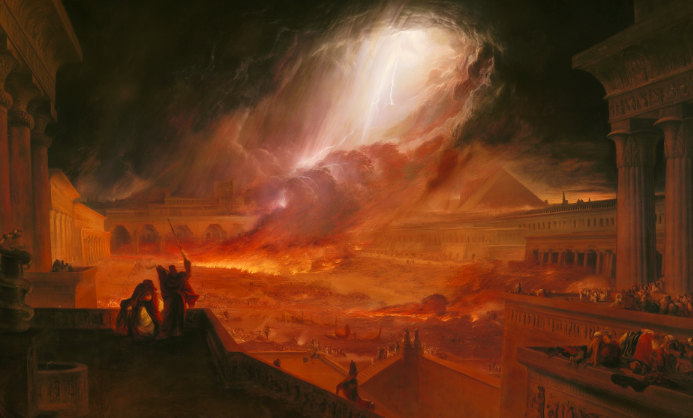
Black Ash is closing the Promenade, a full day of visual art and music, on Saturday 23rd January. The piece is created by LightSounds and mixes audio visual art to create the piece. Learn more about what you can expect:
1. What inspired Black Ash?
The script and visuals of Black Ash carry on from Black Wasteland, an earlier work by the visual artist Yuchen Li (Lychen). In it, he explored how symbols, materials and visual structures take part in constructing and transforming reality. It was Black Wasteland that inspired the composer Hangrui Zhang to write the music for Black Ash.
With Black Ash, we wanted to take this exploration a step further, shifting our focus from how the outside world is transformed to how the subject itself is formed. We began to ask how much of our identity is innate, and how much keeps forming under the influence of our emotions and experiences, social structures and the world around us.
The piece draws on Nietzsche’s Thus Spoke Zarathustra, alchemical philosophy, and Deleuze and Guattari’s A Thousand Plateaus, but it doesn’t try to put forward a fixed argument. Instead, it takes these ideas as starting points to explore becoming as a process that never stops.
The work unfolds through five states of consciousness: a pre-subjective existence, self-projection, social codification, an ontological collapse, and finally the possibility of generating meaning autonomously.
2. What does it mean to you to bring live art to life together during Promenade?
In Promenade’s live painting set, the painters and musicians respond to each other and improvise a performance together in which image and music are closely integrated. Black Ash takes a similar approach. For us, presenting it as live art at Promenade means it is no longer limited to a performance in a single medium. It brings several media fully together, rather than letting the visuals or the music lead with everything else in support.
The work combines moving image, set design, the spatial environment and a live ensemble, Rothko Collective, so that everything physically present in the room becomes a medium for the work.
We’re particularly interested in the relationship between digital images and reality. A digital visual world can be manipulated, expanded and transformed without physical limits, while the audience is physically present, within the conditions of time, gravity and space. Bringing these elements together creates a dialogue between the virtual and the real. We hope people won’t just watch the work, but will truly share the same physical space with it.
3. With visual and audio art, what do you think audiences need to expect?
We hope audiences won’t try to understand Black Ash as a conventional linear narrative. The work unfolds through a series of constantly changing states, in which image, sound and atmosphere influence one another.
The visual environment moves between vast cosmic landscapes, monumental architecture, theatrical spaces and abstract material forms. The music isn’t an accompaniment to the images; it’s one of their sources. It builds a soundscape that keeps changing shape, bringing tension and conflict through rhythm, texture, timbre and musical structures inspired by the architecture in the visuals. Together, image and sound shape the rhythm, tension and emotional intensity of each stage.
We don’t explain everything directly. Instead, we hope to create an immersive experience that lets different interpretations arise naturally.
4. What has been the most enjoyable part about creating Black Ash?
One of the most rewarding parts has been translating abstract philosophical ideas into visual, sonic, physical and experiential forms.
We often start with an idea that’s hard to put into words. Then, through experiments with 3D imagery, moving image, sound and materials, we gradually discover how the idea might take concrete form.
What we enjoy most is the process of the different media beginning to influence one another. Sometimes a visual experiment changes how we understand a scene; at other times, a sound takes the images in a completely new direction. The process isn’t simply about visualising an idea. It’s about letting the meaning and definition of the idea itself keep evolving as we create.
Black Ash closes the Promenade Art piece at Jerwood Hall on Saturday 23rd January. Many thanks to Hangrui Zhang and Yuchen Li (Lychen) for answering our questions. Book your tickets here!
Leave a Reply