
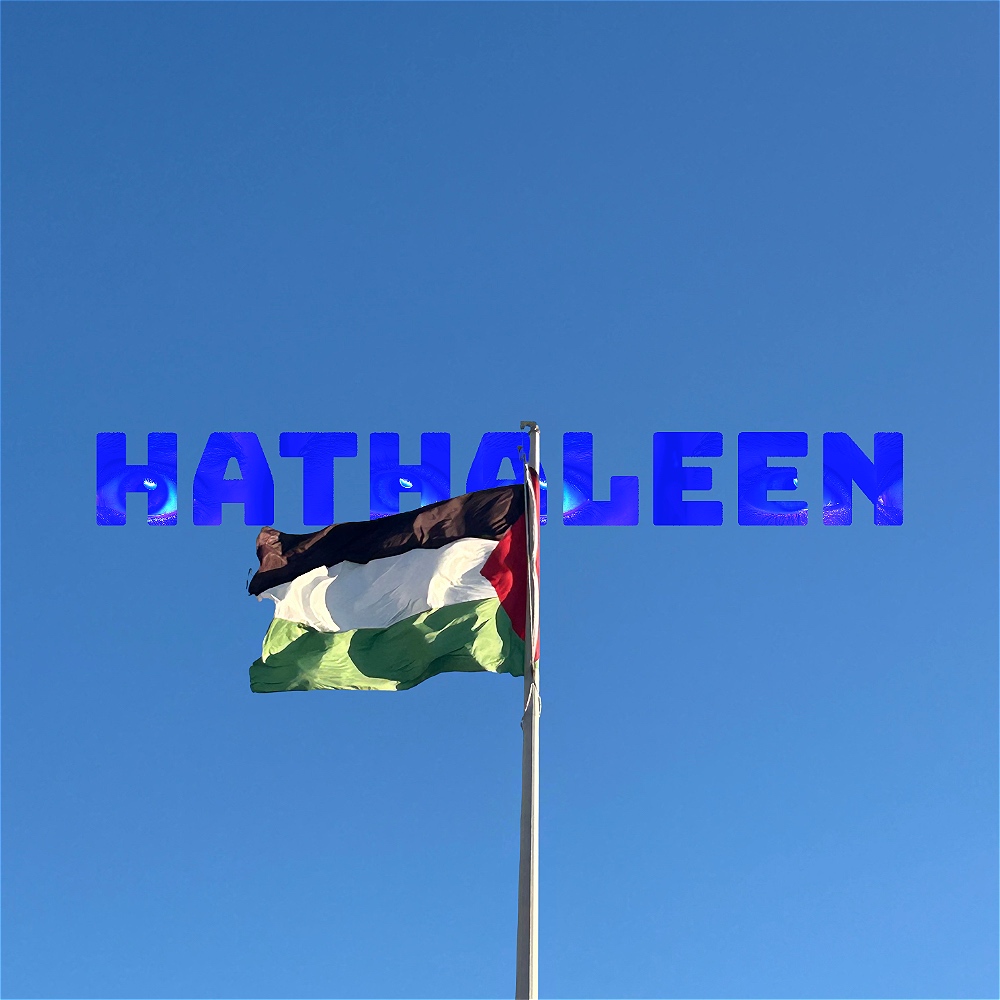
Hathaleen: The Unexpected Journey to Palestine opens Wednesday 12th August at the Arches Lane Theatre, taking you on an unexpected trip to Palestine. Learn more about what to expect:
1: How did you find the balance between the humour and serious topics?
From the outset, I knew the play’s premise—a man impulsively travelling to Palestine to impress his ex-girlfriend—lent itself to farce. Although inspired by real events, I wanted the story to embrace comedy. Leon’s character, a well-meaning but hopelessly out-of-his-depth romantic, creates opportunities for humour as he stumbles through a culture and way of life he knows very little about. His misunderstandings and misplaced confidence become the engine of the comedy, allowing the audience to laugh with him, and sometimes at him, as his worldview is challenged.
At the same time, I have experienced the reality of life in the West Bank, and I knew the play ultimately had to confront the gravity of that experience. For me, humour is not a way of avoiding difficult subjects but of inviting audiences into them. It lowers defences and creates empathy without becoming didactic. Once an audience has invested in the characters through laughter, they are often more willing to engage with the harder truths that follow.
Laughter and grief are surprisingly close emotional states. Both are instinctive, physical responses, which makes it possible to move quickly between comedy and tragedy without either feeling unearned. Finding that balance was one of the greatest challenges of writing and directing the play, particularly because it is rooted in real people and real events. There were moments when I questioned whether certain jokes went too far, and it was often the cast who encouraged me to trust the play’s comic voice. They reminded me that, if we had committed to making a black comedy, we couldn’t become timid whenever the material became uncomfortable.
Inevitably, the play will divide opinion—and, in some respects, it already has. That’s the nature of making work that tackles contemporary politics through satire and humour. My hope, however, is that audiences will recognise the care, compassion, and sincerity with which it has been made. While the play is deeply personal, we have worked hard to make it accessible to audiences with little prior knowledge of Palestine. Humour is central to that ambition: it opens the door to a story that might otherwise feel daunting, before revealing the emotional weight that lies beneath.
2: The title says “The Unexpected Journey.” What is this journey really about?
The story follows Leon, a Zionist hopeless romantic who unexpectedly runs into his pro-Palestinian influencer ex-girlfriend, Thea, at a cafe after they’ve spent the day on opposite sides of a nearby protest. When Leon discovers that Thea has been flirting with an Australian traveller planning a trip to Palestine, his jealousy gets the better of him. In a desperate attempt to impress her, he lies about having his own travel plans. But when Thea enthusiastically insist he goes, Leon is forced to follow through on a trip he never intended to take.
This play is a story about learning to find compassion for those who you are taught to hate as Leon traverses the southern West Bank, meeting all walks of Palestinian life in Hebron and Masafer Yatta.
3: You mentioned the show is loosely based on your own experiences in the West Bank. How much of the story is autobiographical?
I would describe the play as autofiction. It is a fictionalised retelling of real-life events, with characters based on real people or, in some cases, fictional composites drawn from several individuals I have met throughout my life.
Certain elements have been adapted to create greater dramatic scope, particularly the Hathaleen family tree. In the play, Awdah’s cousin Ahmad becomes his uncle, while Haj Suleiman (Awdah’s late uncle in real life) is reimagined as his father. This change introduces an older generation into the story, allowing for conversations about the British Mandate—the period of British rule before the creation of Israel—and Britain’s significant role in shaping the history of Israel and Palestine. I feel this is an important aspect of the conflict that many audiences are unfamiliar with. Although the play takes these creative liberties, the events themselves are rooted in truth and broadly follow the journey I experienced in the West Bank.
4: Could you tell us a little more about Awdah Hathaleen and why the production is in his memory?
On 28 July 2025, Awdah Hathaleen was shot and killed by settler Yinon Levy following an incident in which nearby demolitions ruptured the village’s water pipe. I had been staying in Umm al-Khair, Awdah’s village, shortly beforehand, and the play draws on accounts from friends who witnessed the events to explore both the circumstances of his killing and the wider reality of settler violence experienced throughout Masafer Yatta.
A year later, we held a memorial for Awdah in London, where the actor portraying him read an extract from the play. Since his death, I have remained in close contact with Awdah’s family. Their grief is immense, compounded by the constant fear of ongoing attacks. In recent weeks alone, the community has endured multiple settler attacks and another demolition. The settlement of Carmel, that towers over Umm Al-Khair just twenty metres away, has been expanded by over a third since I was there. Yinon Levy is also yet to be imprisoned.
In Awdah’s memory, we are currently raising funds to deliver theatre and filmmaking workshops for children in the refugee camps of Hebron and in Umm al-Khair. At its heart, this play seeks to give audiences a deeper understanding of everyday life under occupation in the West Bank—a reality that is often overlooked amid the catastrophic events unfolding in Gaza.
5: Why did you choose a multimedia format?
My background is primarily in film, having worked as a Video Assistant on high-end productions, so I always knew I wanted to bring that technical experience into my theatre practice. Throughout the play, I incorporate pre-recorded FaceTime calls and Instagram as integral storytelling devices rather than simply visual embellishments.
I first experimented with many of these techniques in a recent production of Duncan Macmillan’s People, Places and Things, where I found they significantly enhanced the narrative. They ground the story in a contemporary world, making it feel immediate and authentic. Achieving this effect presents unique challenges for both the actors and myself. The FaceTime sequences, for example, are pre-recorded in real time without the opportunity for editing, requiring one actor to respond live to a fixed recording while maintaining the illusion of a genuine conversation. It is an arduous and time-consuming process, but one that I believe is highly effective, creating a distinctive theatrical language that is still relatively uncommon on stage.
I have also been greatly inspired by the work of Kip Williams, particularly his production of The Maids at the Donmar Warehouse, which seamlessly integrates live phone footage, on-screen text, and emoji overlays into its storytelling. His work demonstrates how digital media can become an expressive theatrical language rather than a gimmick. It is amazing how successfully you can use these same techniques on a minimal budget just with some clever overlays.
For this play, that approach felt especially important because social media is central to contemporary Palestinian life. It is one of the primary ways communities document and share events with the outside world, providing a means of bearing witness that exists alongside traditional news coverage. At the same time, the play interrogates the contradictions of digital culture. Through Thea’s character as an influencer, it explores how the pursuit of visibility, engagement, and followers can shape—and sometimes distort—the way people present events online. In doing so, the production examines both the power and the pitfalls of social media as a tool for activism, storytelling, and self-presentation.
6: What has been the most enjoyable part about creating Hathaleen: The Unexpected Journey to Palestine?
Without question, the most rewarding part of the entire process has been the rehearsal room. Because of scheduling constraints, we condensed rehearsals into Sundays and Mondays, often working ten-hour days. It was an incredibly demanding schedule, particularly for both myself and our lead actor, Benjamin Robinson, who travelled from Cirencester on his only two days off each week in order to rehearse.
The commitment and generosity of the cast have been extraordinary. Having worked on countless productions with many different crews, I can honestly say this company has become a family. The trust, humour, and willingness to support one another have made every rehearsal a joy, even on the longest days. Watching the play evolve through everyone’s creativity and dedication has been the most fulfilling part of the process.
I know I’ll miss those rehearsals enormously. They’ve been inspiring, challenging, and, above all, great fun. It’s difficult to accept that this part of the journey is coming to an end.
Hathaleen: The Unexpected Journey to Palestine opens Wednesday 12th August at the Arches Lane Theatre. Many thanks to Louis Linsey for answering our questions. Book your tickets here!
Max
Leave a Reply