
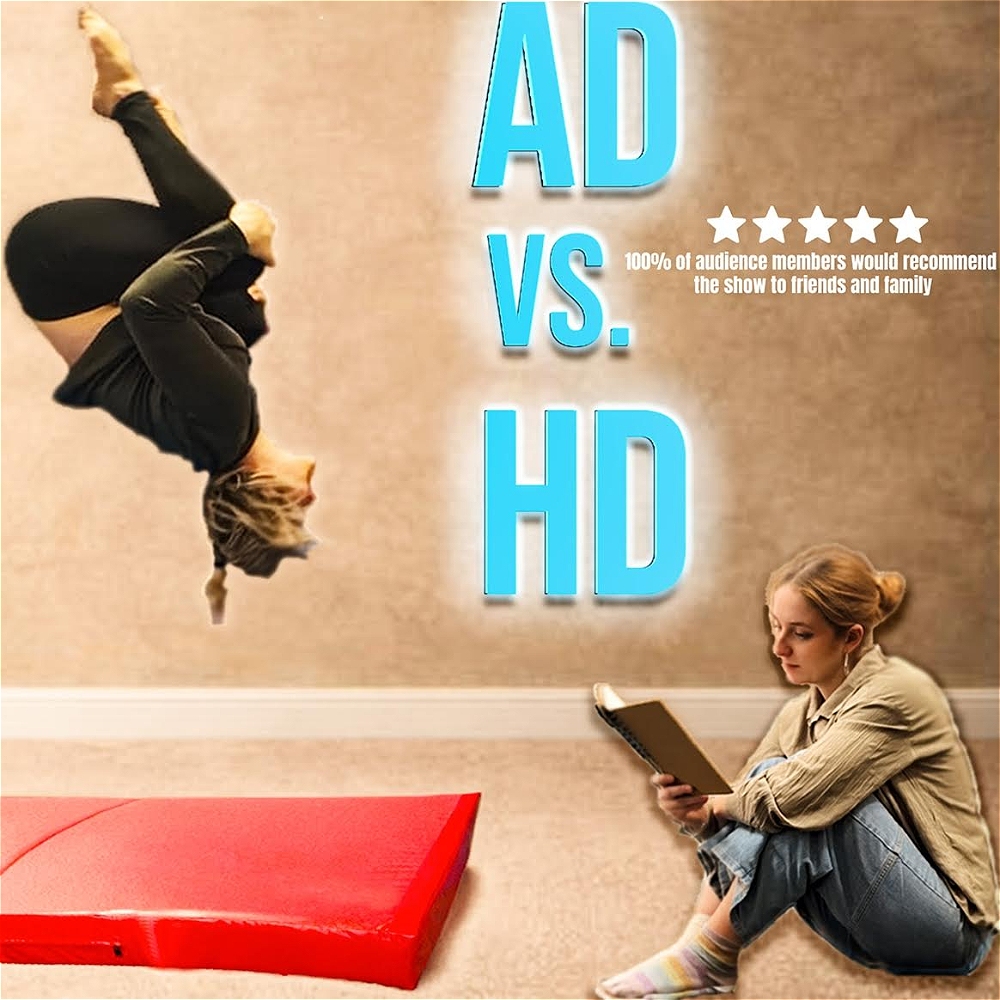
ADvsHD opens Saturday 8th August at the Rosemary Branch Theatre, ready to explore sister relationships and growth. Learn more about what you can expect:
1: Alice and Bea’s relationship seems to be very unique. Is this based on a real scenario?
Yes, good guess! They are based on my sister and I. We both have ADHD and we grew up sharing a room, so I drew a lot from experience. The story is completely fictional though. In the play the older sister has left home and interrupted contact with the younger one, while my sister and I have always been very close, even though we currently live in different countries.
2: How does the play explore the impact of distance on close relationships?
I’d say what it specifically explores is how physical distance can very easily translate to emotional distance. And then it explores emotional distance quite deeply. Relationships take effort and consistency, and when these are lost we end up hurting the people we love.
There is definitely a lot of reflection on that theme in the play. And what transpires is that better communication could avoid so much so easily.

3: How did you approach portraying ADHD in a way that feels authentic?
The sentence I had on replay in the back of my mind while writing this play was “show, don’t tell”. I think our director Ilker Ozturk did an awesome job with that as well.
The ADHD is not so much in what is said but mostly in the actions and patterns of behaviours that the sisters display. In the way they approach tasks and how they go about their day.
We have had audience members with ADHD come to us after our previous performances and tell us that they felt represented in the play, so it looks like we are doing a good job.
4: ADHD can vary between one person to the next. Is this something you are attempting to tell the audience through ADvsHD?
Yes, absolutely! This is one of the central themes of the play. The sisters display almost opposite behaviours, even though their brains work similarly.
Bea, the older, is very physically hyperactive, while Alice’s hyperactivity is all internal: her thoughts never stop coming at her from every direction.
Therefore Bea appears very productive and Alice very static and distracted, but if we observe their behaviour closely we realise that while Bea is quite good at beginning a task, she rarely finishes it. On the other hand, Alice comes and goes from her tasks more slowly, which also allows her to find longer windows of focus.
Their timings are different, but their inner monologues are similar.

5: What was the biggest challenge in bring these two sisters to life?
As I mentioned earlier, Alice and Bea are based on my sister and I. But while creating the characters I let my imagination take charge and made them into quite different people. I also mixed and matched some of our characteristics and behaviours.
So I’d say the biggest challenge was separating them from the people they are based on, both as a writer and then, after, as an actor. Especially considering the story is completely fictional, so I had to immerse them into the imaginary scenario I was creating.
6: What has been the most enjoyable part about creating ADvsHD?
I think the most enjoyable part was probably solving the biggest challenge I faced: I knew the conflict between the sisters had to come from somewhere bigger, but I couldn’t decide from where.
And then the conclusion just came to me one day and it made the whole story click.
I won’t tell you what it is, you’re going to have to come watch the play and find out!
ADvsHD opens Saturday 8th August at the Rosemary Branch Theatre. Many thanks to Sara Bei for answering our questions. Book your tickets here!
Leave a Reply