
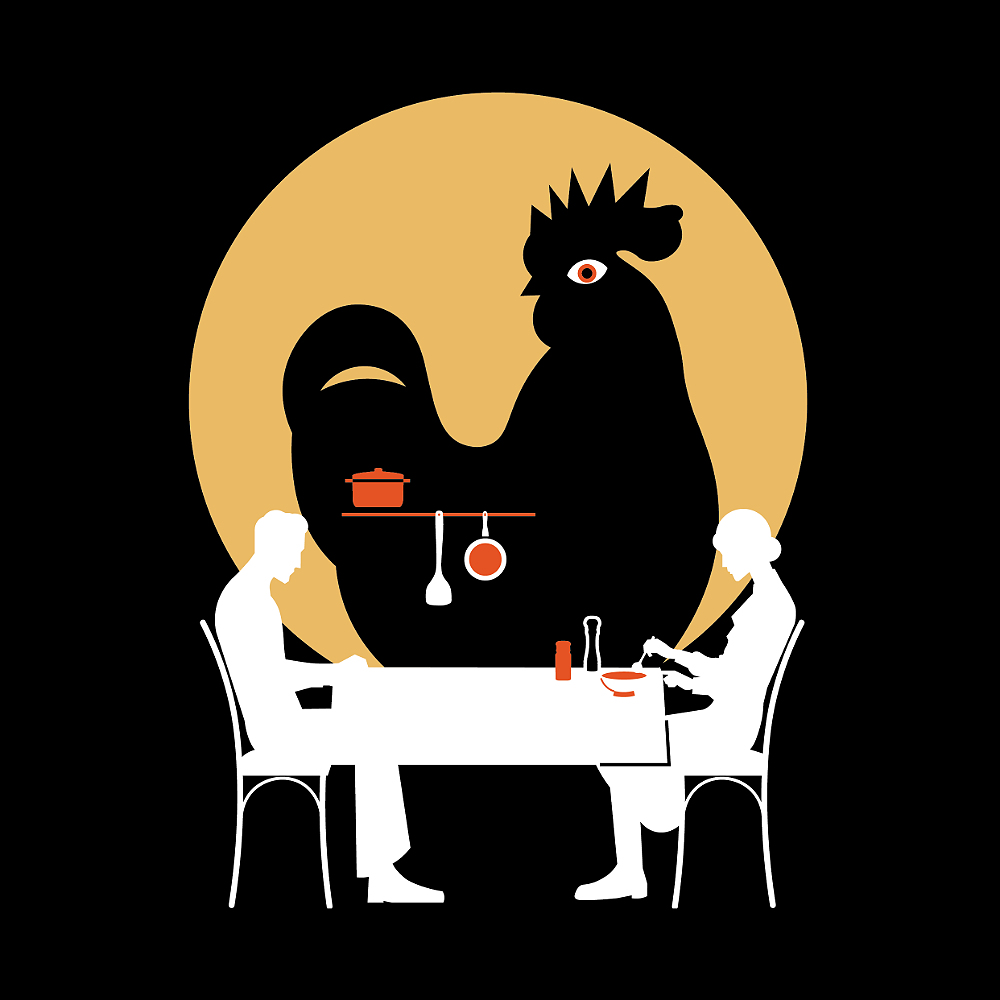
Chicken Dropping opens Monday 17th August at the Etcetera Theatre, being an absurdist comedy involving a chicken invasion. Learn more about what you can expect:
1: You wrote this play after your friend returned to a city under bombardment. At what point did you realise that experience would work as a play rather than another form of storytelling?
This piece came out of my anger. Any art form could carry strong emotion, of course, but what’s special about theatre is liveness. It puts the people who made the work and those watching it inside the same room, with the same atmosphere, at the same moment, feeling the same thing.
What I want my audience to feel is the very specific anger I felt reading the comment sections under war coverage: people showing off their “happy, peaceful lives” underneath the horrifying news, and militants cheering the fighting on. In that sense, the theatre is just like one enormous AirDrop, or a giant Bluetooth, for passing a feeling straight from one person to another.
2: The play is described as a dark absurdist comedy. How do you balance serious subject matters with comedy?
The biggest part of the work was extracting the elements of a serious subject, and then tying them back to everyday life closely enough that the audience can access the story easily, without being frightened off by a heavy, oppressive atmosphere before it has even begun.
The opening is deliberately light: mostly comic material and banter, so the audience settles in thinking this is merely an easy comedy that occasionally tells a dark joke. Then, gradually, the piece lands on what it is actually about. By the time they notice, they are already trapped in the question of what role they themselves have been playing, every time they scroll past the news of a far-away war.
3: How did your professional background influence the script?
My training at the National Academy of Chinese Theatre Arts and RADA taught me to build a narrative structure that serves the story I want to tell. This structure is also the vehicle that enables meto balance a serious theme with comedy.
I combined the “qi-cheng-zhuan-he” (setup, development, turn, resolution) of traditional Chinese opera with Shakespeare’s five-act form, so that long comic stretches never drift away from the subject and long serious discussions never exhaust the audience, with every scene carrying a twist that keeps people curious.
I also borrowed a great deal from new writing: while drafting, I turned the stage directions, and the characters’ emotions and reactions, into a visual layout on the page, using indentation and gaps.
4: What will audiences take away from Chicken Dropping?
I grew up in a creative environment in which the entire system, from the top down, insisted that art must educate people, which drained an enormous amount of the pleasure out of the art itself. So with this piece I have tried to avoid anything that risks being “educational”.
With the economy sliding, politics turning conservative and everyone living under real pressure, what I want most is for the audience to feel light while they are watching my work, and to laugh out loud, whether because a line genuinely strikes them as funny, or because they enjoy watching us mock our protagonist. I think that is the most important thing I can give them through my work.
And when they get home, I sincerely hope they realise and remember that war today is connected to every one of us, and that our own hometowns could become battlefields at any time. Not everyone has to march in the street, or give up their daily life to campaign, but at the very least, try to look the suffering of war in the face. Don’t package it, and don’t glorify it.
5: If you could change one part of the show, what would it be and why?
If the budget allowed, I would portray a completely real domestic kitchen on stage, the kind of set you would see in a production of The Beauty Queen of Leenane. I want the audience to feel, physically,
how a war outside slowly eats its way into the inside of an ordinary household. The whole story would become far more profound if it unfolded in a kitchen that looks like the one in your own home.
That being said, the design we currently have is far cleverer than anything I expected. Our set designer, Shunsuke Imai, has fused the signature elements of the script into a single space and built every set piece by hand. Everyone in the team was astonished.
6: What has been the most enjoyable part about creating Chicken Dropping?
Responding to constructive feedback has been surprisingly enjoyable.
All the way through I have been consulting my tutors and classmates, and my director, Zhaoyi, took me and the rest of the company through very detailed text work. When I first heard the notes, every instinct in me resisted them, but the process of making the changes has been a joy.
I have seen this piece slowly turning from my own personal expression into a story that can reachafar wider audience. For me, a new writer from China working in English, telling the Chinese stories I know matters enormously.
Chicken Dropping opens Monday 17th August at the Etcetera Theatre. Many thanks to Dongmeng Chen for answering our questions. Book your tickets here!
Leave a Reply