
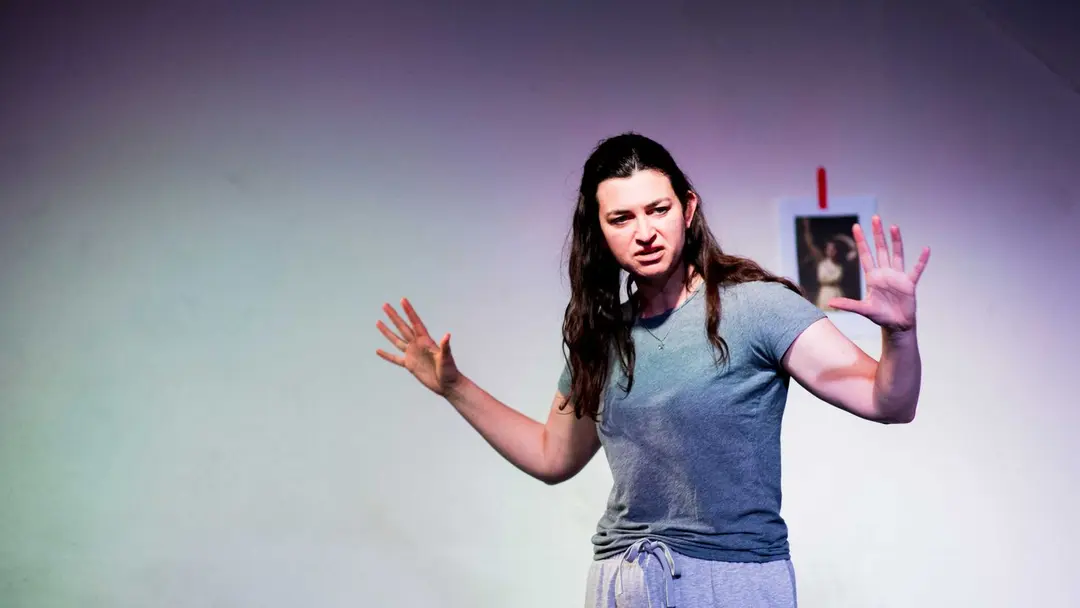
Saving Myself opens Wednesday 14th October at the Bread & Roses Theatre, showing a honest and poetic tale. Learn more about what you can expect:
1: What was the initial spark that inspired Saving Myself?
The original idea came from attached a Rapid Response evening at Theatre503. In response the play I was seeing, the idea of what happens when somebody has been told the same story about themselves for so long becomes what they believe in.
I became interested in blame: how it can begin with something almost trivial in childhood: something breaking, something disappearing, a silence around a dinner table, and how this gradually become part of a person’s identity. If you are repeatedly told that you are the problem, at what point do you start looking for evidence that they might be right?
From there came Lilly, and alongside her came folklore. I started to be fascinated by the idea that something inexplicable inside us might once have been described as a curse, a demon, an inheritance. Lilly begins to borrow that language because ordinary language has failed her.
The play grew out of the space between those two things: the stories other people tell about us, and the stories we create in order to survive those tales.
2: Who is Lilly deep down and how did you develop her?
Deep down, I think Lilly is someone trying desperately to make sense of herself.
She is intelligent, funny, angry, imaginative and sometimes infuriating. She is also someone who has spent a great deal of her life being interpreted by other people. Everyone seems to have an explanation for Lilly before she has had the chance to find one for herself.
It was important to me that she didn’t become simply “a traumatised person”. Trauma is something that has happened to them; it isn’t the entirety of who she is.
I developed her through fragments initially: memories, images, repeated phrases, things she might have been told as a child. Gradually those fragments began to form a voice. Then the director Julia Stubbs and actor Jessamy James brought other layers completely. Once they began to examine the text, creating a work, examining the character, rhythms, references, meaning appear that you could never discover on the page. Resonance happens.
Across Brighton and Camden, through Julia’s direction and Jessamy inhabiting the character, Lilly has continued to change. We have learnt where she resists the audience, where she lets them close, where she is performing and where something much more private slips through.
I think that uncertainty is part of who she is.
3: The play is about taking back your own story. What does this mean?
For me it means recognising that the stories told about us are not necessarily the truth.
We inherit narratives all the time. Families create them. Communities create them. Relationships create them. Sometimes they are affectionate and come from a place of love: “you’re the clever one”, “you’re the difficult one”, “you’re the quiet one”, but sometimes those descriptions become cages.
Lilly has inherited a particularly damaging story about herself. She has been taught to connect herself with things going wrong, and after experiencing violence she starts to incorporate that into the same mythology: perhaps there really is something bad inside her.
So taking back her story isn’t simply about declaring that everything is fine. It is much more difficult than that.
It is about asking: Who gets to name what happened to me? Who gets to decide what it means?
There is something almost alchemical about storytelling. The facts might remain unchanged, but the meaning of those facts can shift. Lilly can’t undo what has happened to her. What she can begin to change is who owns the telling.
4: What drew you to mixing artistic styles together?
I don’t think Lilly could tell this story entirely through realism.
There are moments when ordinary language isn’t enough for her, so she reaches towards poetry, mythology, ritual and image. Those forms allow her to say things indirectly that she isn’t yet capable of saying plainly.
That interests me enormously.
Folklore in particular gives us this strange inherited vocabulary for fear. Demons, possession, curses, changelings, witches. They are fantastical ideas, but they often sit on top of very human anxieties about bodies, difference, sexuality and behaviour.
The play also has a kind of visual grammar. There are books, fragments of paper, objects and the candle. They begin as ordinary things but gradually acquire other meanings. I come from a visual-art and photographic practice as well as theatre, so I am naturally interested in what an object or an image can suggest without having to explain itself.
I wanted the play to feel as though Lilly is constructing something in front of us: half confession, half ritual, half story.
I know that’s three halves, but I think Lilly would probably approve.
5: What do you think audiences will resonate most with?
Possibly the feeling of having been misunderstood.
The circumstances of Lilly’s story are very particular, but I think most of us know what it is like to have somebody else form an idea of who we are and then discover how difficult it can be to escape that version of ourselves.
There is also something recognisable in Lilly’s attempt to impose order on chaos. She collects stories, images, rituals and memories because she desperately wants things to add up.
Human beings do that constantly. We create narratives because randomness is frightening.
What has interested me watching the audiences in Brighton and Camden is that people respond to different parts of Lilly. Some respond to her anger, some to the humour, some to the mythology and some to the much quieter moments when she is simply trying to work out whether she can trust herself.
I hope people don’t necessarily leave thinking they have “understood” Lilly completely. I would rather they leave still thinking about her.
6: What has been the most enjoyable part about creating Saving Myself?
Watching something that existed privately become communal.
Writing can be extraordinarily solitary. For a long-time Lilly existed as sentences on paper, a screen, images in my head. Then Julia began directing it and asking questions of the text. Jessamy began speaking the words aloud. Suddenly pauses mattered. Movement mattered. Where an object was placed mattered.
Then an audience arrived.
That transformation is theatre.
Brighton was particularly special because it was the first time the play existed fully outside us. Camden allowed us to look at it again and deepen it. Now, coming to The Bread & Roses for Lambeth Fringe, there is a sense that this first chapter of the play is completing itself.
Perhaps the most enjoyable part has been discovering that a play is never quite finished when you type the final line.
It keeps being recreated: by the director, by the actor, by the room, and finally by everyone who sits in the dark and brings their own stories to it.
Saving Myself opens Wednesday 14th October at the Bread & Roses Theatre. Many thanks to Tim Stubbs Hughes for answering our questions. Book your tickets here!
Leave a Reply