
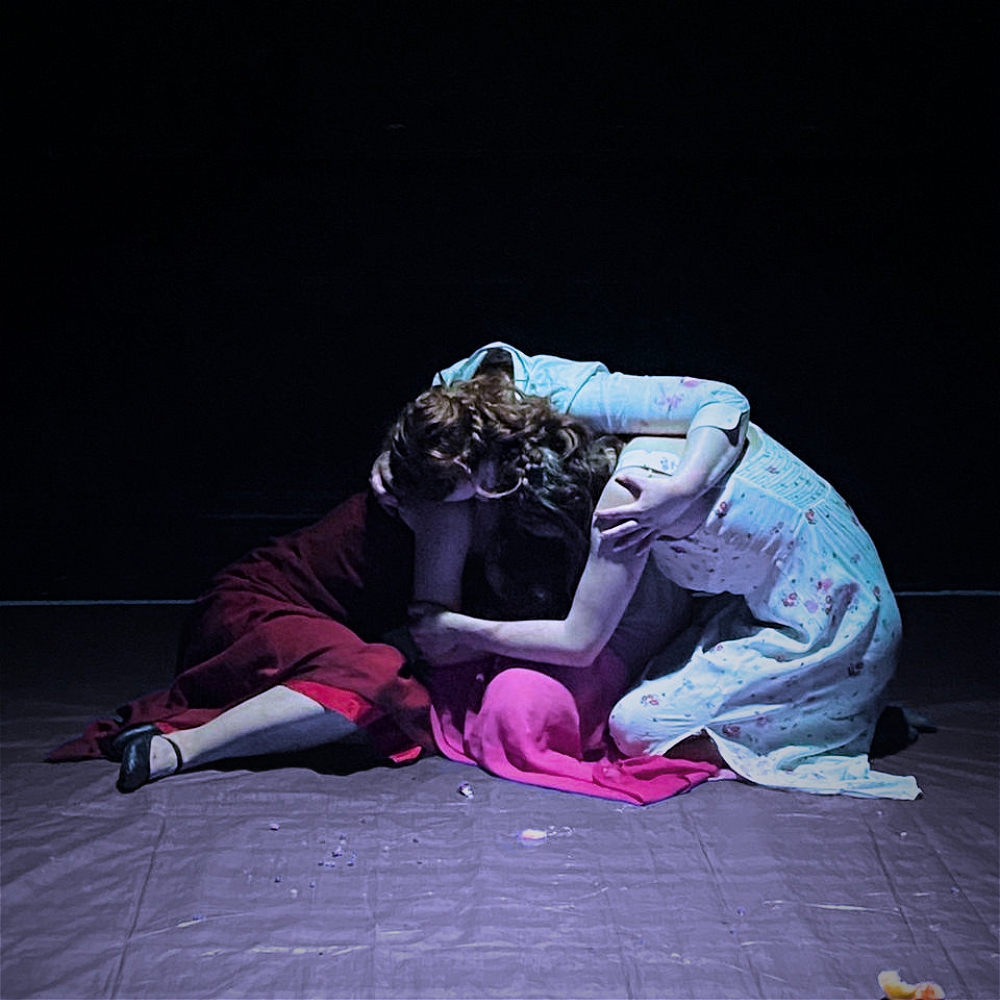
Russian Roulette opens Saturday 8th August at the Rosemary Branch Theatre, being a deeply personal depiction of eating disorders and systemic misogyny.
1: The play is described as abstract. Why did that feel like the right approach for this story?
It mostly has to do with the subject matter. My main issue regarding the depiction of eating disorders in media is that more often than not, they focus solely on the patient’s appearance and behavioral aspects of the illness, to the point where they almost resemble an instruction manual for how to be sick, doing more harm than good. I wanted this show to focus more on the mental turmoil and the internal conflict surrounding eating disorders, and I thought setting it in a liminal space that represents the main character’s mind would be the most compelling way to do it. This was just the beginning of building that world. Using my main creative inspirations such as Sarah Kane and Theatre of Cruelty, as well as studying performance art, my team and I managed to create a world that builds real emotions in a very creative way that makes people think about the wider context that the play represents.
2: The friend appears to be both protector and antagonist. How did you develop that dynamic?
In my own experience with eating disorders, I found myself imagining my illness as its own person, one that drew elements from real influences in my life that contributed to it. I called her Femme Fatale, and she represented everything I wanted to be, or everyhting my illness made me think I should be. It was abundantly clear that I wanted this persona to be a character in the play, however it seemed way too easy to just make her evil. I wanted to give her nuance and make her a symbol of criticism towards the patriarchal system that raises women to turn against their own bodies thinking this is normality, and to turn against each other in the name of being accepted by the same system that makes them sick. As I developed the character of the Girl that I am portraying, alongside the immensely talented Erica Gouveia, who plays Femme Fatale, and also our incredible actor and dancer Christina Leitner as Shadow, we built a toxic mother-daughter dynamic that derives from our own experiences and interpretations of our characters, and we painted the image of a young girl who is finding her place in the world, and an older woman who was brought into a sick community, and who is desperate to bring more people into it as a means to bring herself comfort.
3: What role do movement and physicality play in telling the story?
Answered by movement director Krystine Papathomidou: There are certain things, especially in a topic so dependent on bodies and physicality such as eating disorders, that cannot be described in words. Movement is a more mellow way to communicate such intense emotions and situations in a way that takes care of the audience by not giving them all the answers directly and letting them fill in the blanks instead of just giving them raw explicit words and images. We’ve been building each characters’ physicality through devised explorations to really make them come alive, and it’s given an extra layer of nuance to the world and the story.
4: The play suggests that girls are “sculpted by foreign hand.” What does that phrase mean to you?
The foreign hand to me is a metaphor for the patriarchy. It is a terrifying truth that women are born into certain expectations, and how everything we learn very sneakily leads us to shrink ourselves, both literally and metaphorically. Not only are we taught that thinness and fragility is the standard of beauty, especially in the last few years, but we are also forced to be quiet and submissive, and labeled “difficult” when we choose not to conform into those ideals. It all comes from a need to make women take up less space, and it has been shown that all this gets even more heightened at times where fascism is on the rise. This is why this play is so prevalent today, with the far right having taken so much power, and by extension, the rise of GLP-1 weight loss drugs, and women globally seeming to shrink more and more, the patriarchy is trying to erase us, and we need to speak up about it.
5: How does audience participation work within the piece?
We wanted to showcase a divide between the mind of the Girl and the outside world. We have an amazing ensemble run by Jules Luchs as the MC, and three guards, Matt Flynn, Emmy Khan and Francis Thurstun-Crees, who essentially all built their characters from the ground up. They make the audience part of that world by giving them tasks to follow, treating it as a game with a dark twist. It is about showcasing how systemic misogyny manifests in the world, what the role of the observer is and how that system intrudes into a young woman’s mind and goes on to completely alter her perception. When the two worlds meet, we see how people individually cope with being part of it.
6: What has been the most enjoyable part about creating Russian Roulette?
Honestly, getting my team together and seeing everyone put in a little bit of their genius into the project to make it even richer has been incredibly fulfilling. I initially approached director Angelina Voznesenskaia to work on this play with full trust that they would elevate the script like no one else, but theirs and everyone else’s genuine passion towards the story and the characters are what made this experience so precious to me. I started writing this piece as an attempt to figure out my own self, and having built a community around it to help me make it into a full story is something I greatly cherish.
Russian Roulette opens Saturday 8th August at the Rosemary Branch Theatre. Many thanks to Venice for answering our questions. Book your tickets here!
Leave a Reply